Tuesday, September 21, 2010

Cultural and Social Context

First off, a note of celebration. I have a picture of my object! whoo. However, I do not yet have clearance to post the photos and I was not bored enough at work this weekend to draw a picture. Granted, now that I have a picture I must re-do my first and sort of re-do my second blog post. Alas. But what is grad school without challenges? So in this week's installment of let's talk about a stuffed tiger, we discuss cultural and societal context. This particular tiger, admittedly, has little social or cultural context. In fact, if most people saw him they wouldn't think very much, or would construct a story about who it belonged to (probably a small child) and what its purpose was (comfort). They'd be sort of right. In order to actually get something out of this post, I will once again be broadening the subject to stuffed animals in general, and point of some specific tigers in the process.

Cultural Social Context of Stuffed Tigers/Animals:

Original design Tigger at left.
America, surprisingly enough, has a handful of stuffed tigers that function as pervasive cultural references. Two feature prominently in my blog title: Tigger and Hobbes. Tigger is the rambunctious pal of Winnie the Pooh (who much to my five year old self's annoyance is a constantly plague to Eeyore). Tigger in plush form takes two styles, that of the original A.A. Milne design and the more cultural pervasive image produced by Disney. Tigger is well known in America and England among both children and adults, even if they have not read the Winnie the Pooh stories or seen the television show.

Hobbes is in some ways, arguably less well known. Since  Bill Watterson's comic strip ended in 1995, Calvin and his anthropomorphized  tiger pal Hobbes are increasing less recognized by people under the age of 12.* Hobbes, who appears as a stuffed animal to all other characters, comes to life when accompanied by his owner Calvin. He serves often as Calvin's voice of reason and is up to frighten Calvin with a good pounce. Hobbes often waxes lyrical about humanity, life and other philosophical subjects. Both tigers who are stuffed animals to one set of viewers but talking, responsive characters to others allow the creators to play with understanding of childhood versus adulthood, the role of toys in a persons life and influences of ones imagination. In an interview with Honk Magazine in 1987 Watterson noted "'When Hobbes is a stuffed toy in one panel and alive in the next, I'm juxtaposing the 'grown-up' version of reality with Calvin's version, and inviting the reader to decide which is truer'", noting the flexibility of signifiers of  age.

Stuffed animals in general also function as a shared experience in society. As exhibited by the popularity of and emotional response illicited across the population by the story The Velveteen Rabit  and the Toy Story movies, stuffed animals play an important and recognizable role in our society, whether we are willing to admit it or not (returning to the conflict of childhood vs. adulthood). They symbolize traumatic events (the Oklahoma City bombings, the death of Princess Diana, for example), comfort and a myriad of other emotions, demonstrated by the ability to buy a stuffed animal for any event, their display smartly placed right next to the greeting cards in most drug stores. In other cultures, specifically in China and India, stuffed tigers can be representations of gods, faith and power and are presented as ceremonial and celebratory gifts.

For the rest of this post, I am going to indulge myself and post some Calvin and Hobbes strips.


*Cultural understanding gauged on an oh-so-scientific study done on the poor visitors at work who are increasingly my public history guinea pigs. 


Tuesday, September 14, 2010

Object History: Stuffed Animals

Once again, this post comes with a preface: I (still) have not seen my object in any way. So, we will be continuing this experiment with the tiger described in the last post, India, the 2001 Ty Beanie Buddy.

It has been surprisingly difficult compiling the history of the 'stuffed animal'. Semantic issues caused a lot of searches to end in detailed descriptions of taxiderm-ied wildlife. Most commonly, my attempts at determining the history of 'stuffed animals' (as opposed to stuffed toys, which could mean dolls, puppets, plant life, etc) have led to histories of the teddy bear. Changing my search terms to include 'plush animals' helped greatly. This blog will essentially have two parts. First the history of this particular tiger, then a longer history of stuffed animals after the jump.

History of "India" the Tiger:
India began its life in China as one of hundreds of hand/machine sewn, synthetic fabric construction Beanie Buddies marketed towards children in 2001. India is a part of the Ty Beanie Baby empire which began producing small, bean and fiber-filled stuffed animals in the late 1980s. India's sub category was never quite so popular as the original Beanie Baby, and almost entirely purchased by or for children and adolescents as a comforting toy, not as a collector's item. India was then shipped to the United States and sold in a variety of stores including drug stores, toy stores and gift shops. The stuffed animal could have sat in a variety of warehouses and shelves between the time of production and time of purchase. India the tiger is a not a rare stuffed animal, but is very important to Leyla.
This particular tiger stuffed animal was purchased in the United States in 2001 and given to Leyla in the same year by her Aunt and Uncle to serve as source of comfort in a complicated transitional time in her life. She was 16 at the time.  While I am not positive, Leyla seems to be the tiger's first and only owner. The tiger has been re-moniker-ed as Mr. Pugsley, gendered male and been attributed meaning by Leyla, who now sees him as a type of companion. He  has traveled across the globe over the last nine years, going to LA, Philly and Ireland.  He occasionally takes some jaunts through the washing machine, and sometimes finds himself as a pillow for he 'lives' in Leyla's bed. He has had the life of a favorite stuffed animal and Leyla describes him as somewhat mis-shapen and smushed due to his occasional use as a pillow.  Mr. Pugsley could probably tell a pretty specific and substantial story of Leyla's life for he seems to have followed her everywhere throughout the last nine years of her life.

Ultimately, stuffed/plush animals are children's toys meant to comfort and with which to play. Where they were produced, what they are made out of or the number produced weighs little on the security (and anxiety when lost) they can provide to a child. Many of these toys given or purchased in childhood, much like Mr. Pugsley, follow us into adulthood, sit in our rooms at college, and continue to serve as sources of comfort, security and a reminder of specific moments in our lives. 

Follow the link for History of Plush Animals: 

Tuesday, September 7, 2010

Leyla's stuffed tiger.

I must preface this assignment. I have not seen this object in any way shape or form-not in person, not  a picture. I have a very short description of the circumstances surrounding the 'life' of this plush tiger from which I can extract when it was purchased and potentially the city in which it was bought. In order to complete this first assignment, I have located a plush tiger which was purchasable in 2001 throughout the United States. This tiger has been a friend to a woman for the last nine years, a gift from relatives when Leyla moved in with them at the age of 16. Best described as her 'favorite' stuffed animal, this tiger has traveled the country and serves the purpose of a well loved companion. 

After searches through Google, Amazon and E-bay, the most commonly available tiger in 2001 seems to be the Ty Beanie Buddies Tiger named India. This is the plush animal I will be describing for the purposes of this assignment, and which most fits the 'small and round' description I have of the tiger. Of course, this is simply an assumption. Having been the recipient of many a stuffed animal over my life time, I know that the most 'commonly available' item is not what is given as a sentimental gift.


"India" is a plush tiger toy produced by Ty Inc, the maker of Beanie Babies, in 2001. First produced in April 2001, the design was subsequently "retired" (Ty's euphemism for ending production) at the end of the year.  It was made in China and cost approximately $11.00 to purchase in 2001. Today the average price on Amazon.com is $15.00, according to this listing. This plush tiger measures 15 inches long, excluding the tail, and about 5 inches wide.  It weighs approximately 11 ounces and is made of man-made materials including a very soft, fuzzy tylon/nylon pelt, polyester stuffing and P.E. pellets acting at the 'beanie' part of the toy, as stated on the toy's fabric tag. For lack of a better term, this animal is 'smushy', having some ability to hold a sitting position, but is still floppy.* The toy has standard tiger coloration and pattern, with an orange pelt with black vertical stripes and white underbelly, muzzle and inner ears. Its eyes and nose are hard plastic. It appears to be a mix of machine and hand stitching.

Like all Ty produced animals, India has a red heart shaped cardboard hang tag from the right ear, which states the animals given name, production details/style number (09406), age recommendation and a small descriptive poem. India's poem states, according to Stashmatic.com, a collecting website, "India the Beanie Baby/is one of only three tiger styles/ever created".

*Fabric and 'feel' descriptions based on the blog writer's  similarly sized Beanie Buddy cat stuffed animal purchased around 2003.

Friday, September 3, 2010

Switching things around, once again

A new semester seems to mean a new subject for this dear blog.

Philadelphia has been quite hot this summer and limited how much I have baked and cooked. The most exciting thing I concocted was some tomato sauce with my some tomatoes from my garden and some peppers from my neighbor's. Soon it will also be pflaumkuchen season, but that will have to wait.

For the next few months this blog and I will spend some quality time getting to know a plush tiger.

I am quite taken with this project for my Studies in American Material Culture for my graduate work at Temple University. We are doing  project with First Person Arts (link to the left) through the Painted Bride Art Center in Philadelphia. People from the area are providing an object-something loved, something with a story, something perhaps old, new or unfinished, and providing the stories that go with them. Our job is to provide the history of that object, cultural, political or otherwise.  After spending the summer picking the brains of the archeologists behind Washington's Headquarters, I have found the art of finding out what that 'thing' is to be quite intriguing. Less academically minded, the idea of spending an entire semester talking about a stuffed tiger warms my plush animal loving heart.

So whether the semester brings me a Tigger, a Hobbes or any other variety of less well known tigers, I am sure I'll enjoy it in one way or another.

Monday, April 26, 2010

Baumkuchen!

I have negelected this blog, I apologize. I just haven't really gotten any time to cook anything fun lately! School has been disgustingly overwhelming lately and just has not left time for slaving over a stove or oven. Except for last night when I decided instead of working on my urban historiography, I would make baumkuchen. I was originally going to make it for my German nationalism class, but they don't deserve it as much as my urban class did.

I was hoping that making Baumkuchen would put me in the mood to read a lot of books about culture politics in the GDR (I don't think it worked). However, it did challenge my culinary skills. Baukuchen (literally "tree cake" for the layers it makes when cut) is a German holiday cake that is traditionally cooked over an open fire on a turning spit. I do have the ability for an open fire but not a spit, so I went the cheating way and did it under the broiler. Because it is not built over a stick, it does not make such nice tree-esque rings, but it still shows all the layers.


As I found out this is an EXTREMELY time consuming process. I worked on it for 3 hours! But it seemed to be worth it since it was all consumed in class today (possibly aided by the glorious beer provided by another classmate). I think I was less enthusiastic about it than I am about most of my cooking, simply because after three hours the smell was getting to me. It was still tasty anyway.

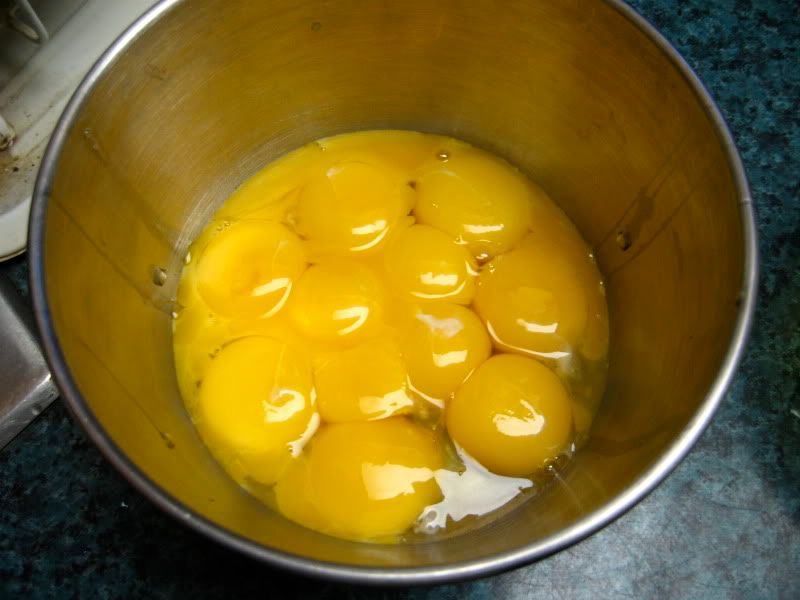
So this is how it begins:

12 eggs!

Follow the link for more!

Friday, March 5, 2010

Bacon!

So, in keeping with the title of this blog, I made something with bacon today! It wasn't bacon wrapped, but there was indeed bacon involved. I don't get to eat bacon all that often. Especially not real bacon with nitrites and pork and all that good tasty stuff. Despite being a good German household that eats all sorts of pork product (there was even blood pudding in the fridge a couple weeks ago...I did not partake), bacon is not in our house all that often. If ever.

Since it is "Spring Break" I am not in as great of a wide eyed panic to get my reading and writing done I have been taking the time to knit, cook real dinners and actually think about my dissertation topic (Channeling Craig Ferguson: I know!). However, I will save the waxing lyrical about representation of communism in Berlin's neighborhood architectural changes since 1990 for another day. And what a fun day that will be.

Speaking of things German and my domestic endeavors, I made spaghetti carbonara for dinner. Yes, you are currently going 'but that's not german, that's italian!' I'm aware, I'm aware. However, the first time I ever had Spaghetti Carbonara it was made by a German, in a freezing little flat somewhere in Edinburgh. It was absolutely delightful, and when I returned to Berlin I found those little Knor packets that let you make complex dishes without actually having culinary talents. So for many a meal while in Berlin, I made spaghetti Carbonara.


I have since then been lazy and just keep making the packets when I want it, mainly due to a significant fear of tempering eggs. Tempering eggs allows you to cook the eggs and include them in a sauce without the egg scrambling (think hollandaise). I figured I would just fail at this miserably and end up either either with salmonella or with scrambled eggs. Today, however, I conquered egg tempering.

(Recipe taken from The Food Network. I only had three eggs, so I added some cream to make them go further. I also used 1.5 cups cheese, well, because I love cheese)

Pictures after the cut...

Wednesday, February 10, 2010

Snow=baking

So, for those of you not on the east coast, particularly those not in the DC/Philly area, it snowed. Twice. With many inches each time. Now, I should be taking these no class, not going anywhere, no errands to run days to complete the six books I have to read before wednesday (and I'm not even behind!), but instead I have made a tiny snow man, shoveled twice read a book and of course, baked.

Saturday (the first snow storm) my baking endeavors were quite dull, simply a box of brownies with vanilla buttercream. I'm not sure why I will bake from scratch almost everything...but brownies.  They aren't hard or complicated. I just can't seem to get them to taste like Betty Crocker.
When it snows my neighbors get bored and thus throw parties, so they got enjoyed by my neighborhood.


Believe it or not I put marshmallows in those. Probably about a cup of mini marshmallows went into the batter. When they were done and I cut them up, the marshmallows were gone. I'm assuming chemistry got the better of me, but still, where did all the marshmallows go?

Today I was slightly more adventurous. When they forcasted another close to two feet of snow,  I went searching for a recipe worthy of a snowy day stuck inside and Caramel Banana Bundt Cake came up.
I like bananas, I like caramel. Bryn Mawr made (or bought, I was never really sure) a really tasty caramel banana cake that came around once in the six week menu rotation. Even if I wasn't planning on going to dinner or if I had work that night and wasn't going to get dining hall food, I made sure to go and get that cake. So, I figured this would be a close homemade substitute.

So, after consulting The Crepes of Wrath, I went to town on making said cake.

The cake part went well. I'm good at cakes. Not too pretty oven shot:


Then came the caramel part. The last time I made caramel I was probably about 13 years old and at the shore house of a friend. I decided I was going to make caramel apple tarts. After three failed attempts at caramel making, the friend's husband Dave had to make it for me. I have not since tried to make caramel. But I'm older, wiser and better with a stove, so it was time to try again.


This time was slightly more successful. The caramel was fine, quite tasty, but I reduced it to be fairly thick. The recipe calls for poking holes in the bottom of the cake and pouring the caramel so that it seeps into the cake (kind of like a tres leches cake). Not being amazingly good at the cause and effect part of life, the caramel kind of sat on the top, and not so much seeping into the cake.

Whoops:


In the end, it came out looking kind of odd (the glaze was kind of runny and well...left much to the imagination) but it tasted wonderful. The bottom with the caramel tasted very nutty and rich while the top with the thin yogurt banana glaze was very light and fruity


Recipe at The Crepes of Wrath. She did a lot of things I didn't. I used vanilla yogurt, no butterscotch chips and I used the remaining vanilla yogurt, half a banana and some powdered sugar to make a little glaze.

I suppose now I should get some  more reading done. Celia Applegate and her A Nation of Provincials is up next. 


Mr. Snowman says hi. He got buried under the extra eight inches of snow we  got between his creation and the second go at shoveling. He is unburied and back to greeting you at the front steps.